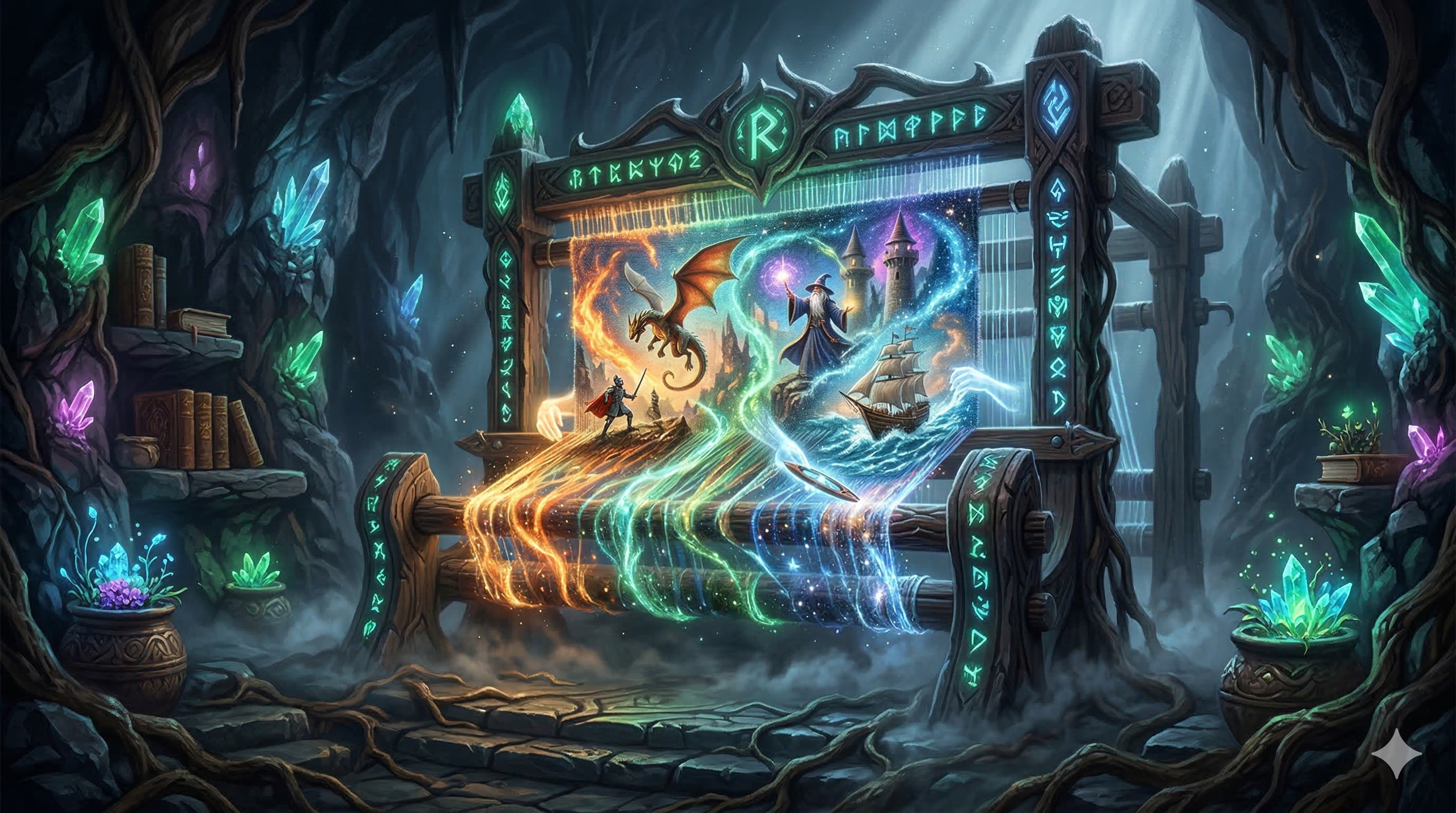
The Master’s Loom
An experimental TTRPG campaign management system, evolving toward a real-time AI-augmented platform.
What Is The Master's Loom?
The Master's Loom is not just an application — it is an evolving system designed to support storytelling, worldbuilding, and real-time campaign orchestration for tabletop RPGs.
This project serves as both a functional prototype and a structured learning journey into modern application design.
🌌 The Vision
The Master’s Loom is a “Single Source of Truth” platform designed to bridge the gap between high-fantasy storytelling and real-time data management. By eliminating paper silos and manual tracking, the system allows Dungeon Masters and Players to maintain narrative immersion while the “Game State” is synchronized in the background.
🎯 Project Purpose
This project is primarily a hands-on learning initiative designed to build practical experience in:
- Application architecture and system design
- Frontend and backend integration
- Data modeling and schema design
- Iterative development across multiple technology stacks
The goal is not just to build a functional application, but to develop a deep understanding of how scalable, modern applications are designed and implemented.
Current Development Path
The Master’s Loom is currently being prototyped in MIT App Inventor as a learning-first build. The project follows a multi-phase development strategy, separating learning from production implementation.
Current Phase (Phase 1 – Prototype & Validation)
- Built using MIT App Inventor
- Focused on learning UI structure and navigation
- Testing core workflows (campaigns, characters, sessions)
- Using local storage (TinyDB or equivalent)
- Rapid iteration without concern for scalability
Why this shift?
The original target stack was FlutterFlow + Firebase, later expanded to consider Supabase. However, because this project is currently self-funded and learning-driven, the immediate goal is to:
- learn core app concepts
- prototype the data model and user flows
- validate the campaign-management experience
- defer platform-specific scaling decisions until later
Planned Build Phases
- Phase 1 – MIT App Inventor Prototype (Learning & Validation)
- Core screens
- Local/simple cloud data
- Campaign, character, session, and notes workflows
- Learning app fundamentals by building
- Phase 2 – Platform Rebuild (Structured Development)
- Rebuild validated workflows in FlutterFlow
- Evaluate Supabase or Firebase for backend services
- Add cleaner auth, data structure, and UX
- Phase 3 – Expansion (Advanced Features)
- Real-time sync
- AI-generated summaries
- Whisper system
- Shared battlemap/state management
🧪 Current Prototype Features (MIT App Inventor)
- Basic campaign creation
- Character tracking
- Session notes
- Local data storage (TinyDB or equivalent)
- Simple navigation between screens
⚠️ Current Limitations
- Prototype built in MIT App Inventor (not production-ready)
- No real-time sync
- No persistent backend yet
- Limited UI flexibility
- Will require rebuild in future phases
Planned Features
- Campaign management
- Character tracking
- Session notes
- World-building elements
- Inventory and item tracking
⚔️ Target Capabilities (Long-Term Vision)
- Live Session HUD: A bi-directional dashboard where player updates (HP, AC, Spell Slots) reflect instantly on the DM’s “Combat Monitor”.
- Chronicle Engine: A multimodal logging system that uses AI to synthesize live session transcripts into automated narrative recaps.
- Interactive Battlemap: A shared digital canvas featuring “Smart Figurines” that track position and status across all connected devices in real-time.
- The Whisper Network: A secure, real-time messaging layer for private plot-point communication without breaking table immersion.
🛠️ Future Architectural Goals
- Low Latency: Low-latency synchronization for critical combat statistics.
- Platform Agnostic: A single-codebase approach ensuring a seamless experience across Web, iOS, and Android.
- AI-Native Logic: Integrated pipelines for narrative assistance, world-building, and session summarization.
- Cloud-Based Backend: Supabase or Firebase for database storage, user management, and secure authentication.
📌 Project Philosophy
This project is intentionally iterative and exploratory.
Rather than aiming for immediate production readiness, The Master’s Loom is designed as a structured learning journey—building, testing, refining, and rebuilding with better tools and deeper understanding at each stage.
📖 Status
🚧 Early Prototype — Actively in development and experimentation phase
📂 Project Documentation
- Roadmap
- System Architecture
- Data Schema
- User Journey
- Tech Evaluations
- Prototype Docs
- Dev Logs
- Learning Log
⚖️ Intellectual Property & Proprietary Rights
Copyright © 2026 Ashley Windsor. All Rights Reserved.
“The Master’s Loom,” its associated brand identity, system architecture, data schemas, and user experience frameworks are the exclusive intellectual property of the author.
Public Disclosure Notice: This repository serves as a public design journal and architectural portfolio. The presence of this documentation in a public forum does not constitute a license for:
- Reproduction or distribution of these architectural frameworks.
- The commercial or private development of software based on these specific schemas.
- The use of “The Master’s Loom” branding or trade dress.
For inquiries regarding collaboration or professional discussion, please contact the author via LinkedIn.